Sunday, February 24, 2013

LG Optimus G with quad-core processor 2013

lg_optimus_g.jpg

LG Optimus G may not have been officially unveiled in the country yet, but it is now available with online retailer Saholic for Rs. 30,990. The website is promising delivery within 4 business days. Rumour has it that the official launch of the phone is around the corner, but looks like retailers have pipped LG on this one.
LG Optimus G was originally launched in September last year. It is powered by 1.5GHz quad-core Snapdragon S4 Pro processor alongside 2GB of RAM. It includes a 4.7-inch 1280x768 (320ppi) display and sports a 13-megapixel rear camera and a 1.3-megapixel front shooter.
LG Optimus G comes with 32GB of built-in flash storage, but no microSD card slot or expandable storage of any kind. Connectivity options include Wi-Fi, Bluetooth, Micro-USB and NFC. The phone originally shipped with Android 4.0 Ice Cream Sandwich, but as per the listing on Saholic, in India, the phone will come with Android 4.1 Jelly Bean preloaded.
With LG already having announced Optimus G Pro in other markets, it looks like the company is getting ready to unveil the Optimus G in India.
LG Optimus G key specifications
4.7-inch 1280x768 display
1.5GHz quad-core Snapdragon S4 Pro
2GB RAM
32GB internal storage
13-megapixel rear camera, 1.3-megapixel front camera
Android 4.1 Jelly Bean
2,100 mAh
131.9 x 68.9 x 8.45 mm

Samsung Galaxy Axiom - U.S.


It may seem hard to believe, with the rise of 5.5-inch phablets like theSamsung Galaxy Note II, but not everyone wants a gigantic smartphone. Even the 4.8-inch Galaxy S III can prove unwieldy for many hands. Luckily, U.S. Cellular offers the $29.99 Samsung Galaxy Axiom, which takes many of the same features from Samsung's larger handsets, and offers them in a comparatively petite 4-inch package. It isn't quite as powerful as Samsung's larger handsets, but it costs a heck of a lot less.
Design - Network - Call Quality
The Galaxy Axiom measures 4.79 by 2.51 by 0.47 inches (HWD) and weighs 4.83 ounces. It looks a little plump, but it's quite comfortable to hold and operate with one hand. It's made out of the same flimsy-feeling plastic as the Galaxy Note II and Galaxy S III, with the same faux-tarnished design on the back cover.

The phone's 4-inch, 800-by-480-pixel display looks bright and sharp. It's a slight step down from the 4.3-inch, 960-by-540-pixel display on the Motorola Electrify M, though. The onscreen keyboard is a little cramped for typing, but you get used to it. There's a physical Home key beneath the display, flanked by capacitive Back and Options buttons.
U.S. Cellular is seventh-largest carrier in the U.S. It runs its own 3G and 4G LTE networks in parts of 26 states. Prices are good, but not significantly better than any of the big four networks. Instead, U.S. Cellular sells itself on better customer service and network quality than other carriers. Our readers agreed, giving the carrier our Reader's Choice award last year, for reasonable prices and a reliable network.
The Axiom supports U.S. Cellular's relatively new 4G LTE network, which, at the moment, is still limited to four major clusters throughout the U.S. We test U.S. Cellular phones in New York City, where they roam on Sprint's network, which can be frustratingly slow. If you're planning to buy a phone on U.S. Cellular, you may want to take a look at the coverage map, in case you plan to spend a lot of time outside of the carrier's native coverage area. You can also stay connected via 802.11a/b/g/n Wi-Fi.
Voice quality on the Axiom is average. In my tests, I heard a lot of static in the earpiece, and voices were somewhat fuzzy. There's aggressive noise cancellation in play here, which makes voices sound somewhat digitized, but otherwise clear. The speakerphone sounds fine and is loud enough to hear outside. Calls sounded good through a Jawbone Era$99.00 at Beach Camera Bluetooth headset. Samsung's S-Voice virtual assistant is on board, and I had no trouble using it over Bluetooth. Battery life was good at 8 hours and 59 minutes of talk time.
Hardware, OS, and Apps
The Axiom is powered by a 1.2GHz Qualcomm Snapdragon S4 MSM8960 processor. That isn't as fast as the 1.5GHz chip in the Galaxy S III and Electrify M, but it still performed well in our benchmark tests. And since the Axiom has a lower screen resolution that either of those phones, it performs just as well for tasks like gaming. You won't have trouble running any of the latest apps or games from the Google Play store, which offers a whopping 700,000+ titles.

The Axiom runs Android 4.0.4 (Ice Cream Sandwich). There's no word yet on an update to a newer version. Samsung has made some modifications to the OS, most of which are the same as you'll find on the Galaxy S III. There's a tiny strip at the bottom of the home screen and an Apps menu that allows you slide through pages just by dragging a finger over it, or you can flick through one page at a time. You get five customizable home screens that come rather aggressively preloaded with apps and widgets. Thankfully, there isn't much bloatware, but what's there cannot be deleted.
The Siri-like S Voice for voice control is on-board, and does a good job with voice commands and searches. There's also Kies Air hidden under the Settings menu, which lets you view your phone's contacts, messages, and media through a PC's Web browser. Additionally, the Axiom supports NFC, and Google Wallet comes preinstalled. NFC lets you use Samsung's S Beam, which, along with Wi-Fi Direct, allows you to transfer files by tapping two phones together. There's also DLNA support for watching content from your phone on an HDTV or monitor.
Multimedia, Camera, and Conclusions
You get 1.71GB of free internal storage. There's also an empty, side-mounted microSD card slot on the left edge of the phone. My 32 and 64GB SanDisk cards worked fine. All of our music test files played back except for FLAC, and sound quality was fine over both wired 3.5mm headphones as well as Altec Lansing BackBeat Bluetooth headphones. All test videos played back too, at resolutions up to 1080p.

The 5-megapixel camera is decent. It takes an average of 1.2 seconds for autofocus to lock in and snap a photo, which is a bit long. But photos show a fair amount of detail and colors look accurate, if not particularly vibrant. Video performance, on the other hand, is mixed. The camera records 720p video at 30 frames per second, but they look somewhat blurry indoors, with a lot of screen tearing; video recorded outside fares much better. There's also a decent 1.3-megapixel camera on the front of the phone for low-res stills and video chat.
As a smaller, slightly less powerful, less-expensive alternative to the Galaxy S III and Galaxy Note II, the Samsung Galaxy Axiom succeeds. It still gets you plenty of power and features, along with 4G LTE support, at a very affordable price. But if you're looking for U.S. Cellular's ultimate Android phone and don't mind the extra size, the Galaxy S III is still a better choice. The Axiom's primary competition is the Motorola Electrify M, which packs even more power into a similarly well-sized package. The Electrify has a more powerful processor and a larger, sharper display, but it also costs more than twice the price as the Axiom, and its camera isn't as good. Both are solid phones, so it comes down to a matter of which design you prefer.


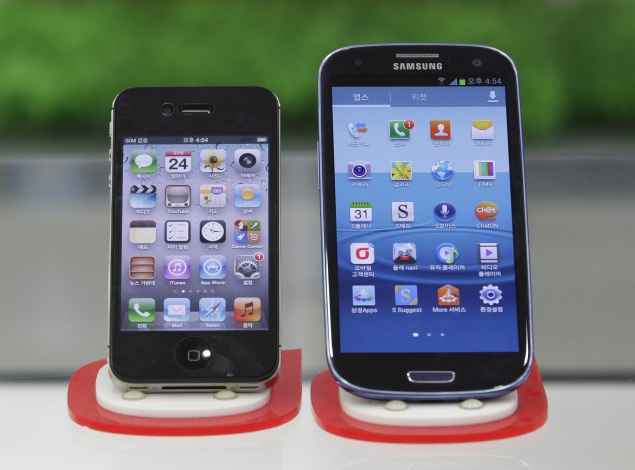
Samsung vs i phone 5

Chinese handset makers will lead an onslaught on smartphone titans Samsung and Apple when the world's biggest mobile fair opens Monday in Barcelona, Spain.

Offering big-screen, slick, slim smartphones at lower prices, Chinese manufacturers Huawei, ZTE and Lenovo will leverage the Mobile World Congress to chip away at the mighty duopoly, analysts say.
apple-samsung-patent-battle.jpg

The handset battle is part of a broader revolt against a handful of companies with a stranglehold on the booming industry's handsets, operating systems and microchips, they say.

Apple, as usual, is steering clear of the February 25-28 congress that draws 1,500 exhibitors to this Mediterranean city in northeastern Spain, and Samsung is not expected to launch its next big offer, the Galaxy S4, until some time after the show.

That may leave the field clear for rivals to tout their ambitions for a slice of the smartphone market, which is set to grow to a record one billion handset shipments in 2013 according to a forecast by global consultancy Deloitte.

"I think we will see challengers trying to make noise at the Mobile World Congress this year," said Ian Fogg, London-based senior mobile analyst at research house IHS.

New players face a daunting task, though.

Samsung and Apple accounted for more than half of all smartphone sales in the final quarter of 2012 - 29.0 percent for Samsung and 22.1 percent for Apple - according to research firm Strategy Analytics.

Behind Samsung and Apple, however, Chinese firms held the third, fourth and fifth spots - with 5.3 percent for Huawei, 4.7 percent for ZTE and 4.4 percent for Lenovo.

Demand for smartphones in developing countries could give Chinese firms a bigger opening, said Magnus Rehle, senior partner at telecommunications management consultancy group Greenwich Consulting.

"Hundreds of millions of Africans and Indians and Asians want to have a smartphone and so far the blocking point has been the price," said Rehle, speaking from Ghana.

Now the Chinese firms were offering attractive smartphones at lower prices, he said.

"I think they will be quite successful in grabbing the new market outside of Europe and the US, and that is where the growth is," Rehle said.

An even mightier duopoly holds sway over the operating system software that makes the smartphones work.

Google's Android ran 69 percent of all handsets sold last year and Apple's iOS 22 percent, said a study by independent analytical house Canalys.

Yet they face challengers, too, including Mozilla's new open-sourced Firefox OS, backed by an array of mobile phone operators.

Microsoft's new Windows Mobile operating system is struggling, however.

"The number of apps that is available is one thing that is blocking Windows from being successful," Rehle said.

"They have had problems and everybody is hoping this will change because the duopoly is maybe not good for the market."

Firefox could face similar difficulties, he predicted.

A battle has broken out, too, over the processor chips that run the smartphones.

Santa Clara, California-based Intel is offering new high-performance chips to break its way into smartphones, of which almost all now use chip technology licenced by ARM, based in Cambridge, England.

Chinese group Lenovo, for example, is launching a new handset, the IdeaPhone K900, just 6.9mm thick with a 5.5-inch high definition screen, which contains an Intel Clover Trail processor.

The potential rewards for Intel could be rich: the market in processor chips for smartphone applications was worth nearly seven billion euros ($9 billion) last year, said Francis Sideco, communications technology analyst at IHS.

Despite robust growth in smartphones and tablet sales, however, the mobile industry still faces a major challenge moving customers over to new ultrafast fourth generation, or 4G, networks, which can offer speeds similar to a fixed fibre-optic connection.

"There are 3G networks in many parts of the world like in Sweden that have been overcrowded and then you have parallel 4G networks that are almost empty," said Greenwich Consulting's Rehle.

Network operators need to convince their customers to pay a little more for the faster speeds, he said, pointing to videos as the "killer application" to lure people to the system over the longer term.

Top 5 phons must-haves për punonjësit celular

The number of mobile and remote workers is increasing every day, though quantifying exactly how many people work from home is impossible. Are you officially a teleworker if you work from home occasionally—say, once a week—or must you commit to a daily practice? According to the Telework Research Network, 40% of U.S. employees (approximately 50 million) hold jobs that that could be done at home; however, 2009 census data show that only 2.9 million employees work from home more than half the time (not including the self-employed). That’s only 2.3% of the workforce— nowhere near our telecommuting potential. While telecommuting’s flexible scheduling and relaxed work environment are often-cited benefits, there are several “green” reasons that make working from home advantageous:
  • In a recent study, the EPA estimated that $23 billion could be saved in transportation, environmental and energy costs if 20% of the workforce worked from home regularly.
  • Telecommuting reduces total vehicle-miles traveled each year by more than 35 billion and conserves almost two billion gallons of gas, significantly reducing our fossil fuel dependency.
  • Employees who work at home reduce or eliminate the need for large offices that require surplus energy for air-conditioning, heating, lighting, and large equipment.
  • Telecommuters tend to use less paper by saving files digitally and in the cloud, thus reducing storage space, the need for larger office or storage buildings and, of course, trees.
For those interested in telecommuting and improving our planet’s health, here are seven must-haves for the home office—without which you’re less likely to establish a successful telecommuting practice.
Smartphone
A smartphone is your lifeline, period. If you don’t already feel that way about it, you will once you begin telecommuting. One of the benefits of telecommuting is a flexible schedule; nevertheless, without a smartphone, you’ll find it difficult at best to remain on top of your schedule and keep in touch with your in-office coworkers. A smartphone bundles vital organization and communication tools that you will rely on. Should you have to run a quick errand, you can pop it in your bag or pocket and continue to be available if someone needs you while you’re away from your home office.
Laptop
Although tablets are becoming increasingly popular in professional environments as a work tool, the laptop reigns supreme and has replaced desktops as the primary device for knowledge workers. Laptops are both powerful and portable, making them the optimal tool for both remote and in-office workers.
Wireless network
Access to wireless networks—especially a home wireless network—makes teleworking incredibly versatile. Searching for free Wi-Fi during your travels can be a challenge, but you’ll find that having internet access from anywhere in your house—or out on the patio—is both liberating and convenient.
Routine and boundaries
I write regularly on the importance of establishing a daily routine and creating both internal and external boundaries as a teleworker. These behaviors work interdependently to establish a healthy work-life balance and help teleworkers remain productive without burning out or getting distracted by non-work related activities.
Availability
It’s important for a mobile worker who is not always physically available in the office to bridge the gap with team members and clients by being available during office hours via technology. Simple efforts such as promptly responding to emails, using video conferencing technology like iMeet to maintain face-to-face connections despite geographic distance and, for part-time telecommuters, leaving contact information available at your office location and in your email signature will ensure your availability and build your colleagues’ trust.
Successful telecommuting is far more than just sitting at home with your laptop while you work on a document, send emails and avoid rush hour traffic. It’s a craft that must be practiced, one that requires a certain aptitude as well as specific tools. To succeed in your telecommuting practice, think of working from home as being self-employed. Yes, you’re still part of the company and a member of a larger team, but within the four walls of your home or the neighborhood Starbucks, you are also your own supervisor. As such, you’ll need to be self-motivated, self-governing, and self-sufficient. Equipping yourself with the right tools and the right processes up front can get your teleworking “business” on track and help it remain personally profitable

HTC One S - T-Mobile 2013


HTC has finally launched its first Android smartphone to ship with Ice Cream Sandwich—and it's a winner. The HTC One S packs a next-generation dual-core processor, a vibrant screen, an unusually capable camera, and fast HSPA+ 42 data speeds, all into one of the slimmest and lightest designs we've seen. Despite a few minor issues, the HTC One S is our favorite new smartphone on T-Mobile and a clear Editors' Choice.
Design and Call Quality
Slim and light, the HTC One S measures 5.15 by 2.56 by 0.35 inches (HWD), with a thinner 0.31-inch portion in the center, and weighs roughly 4.2 ounces. HTC doesn't provide an official weight figure, but the One S is slightly lighter than the 4.9-ounce iPhone 4S we had on hand. HTC's high-end handsets typically feel expensive, and the One S is no exception, with its rounded, gray aluminum body. This one goes several steps further, though. First, it's almost impossibly slim, thanks to its unibody design—the Verizon Motorola Droid RAZR is slimmer still at 0.28 inches, but the difference is largely academic given how good the One S looks. The gradient anodized finish also lends an extra dose of class, not to mention durability. A prominent volume rocker sits on the left side panel, while the top edge houses the Power button and a standard 3.5mm headphone jack.

The 4.3-inch, 960-by-540-pixel, Super AMOLED glass capacitive screen looks beautiful at first glance, with vibrant color, a bright backlight, wide viewing angles, and deep blacks. It's also very responsive; typing on the on-screen QWERTY keyboard is an absolute joy. HTC's own keyboard layout is present, and you can switch on Swype if you prefer that. There's only one issue with the screen: It's a PenTile display. That means the arrangement of subpixels results in mild stippling that many people don't mind (including me), but others find irritating. Mainly, it surfaces in fuzzier-than-typical text, and on dark gray backgrounds; you can really see it when it's next to a phone without a PenTile display. Suffice to say it's worth a look in person to see what you think.
The HTC One S is a quad-band EDGE (850/900/1800/1900 MHz) and tri-band HSPA+ 42 (900/1700/2100 MHz) device with 802.11b/g/n Wi-Fi. Download speeds generally landed in the 4 to 7 Mbps range—good, but not the best we've seen for HSPA+ 42. Ping times were often just over a second—though a few results were normal, at under 100 milliseconds—and upload speeds struggled to break 1Mbps, with most landing in the 500 to 700Kbps range. T-Mobile says our otherwise production review unit isn't provisioned yet for HSPA+ 42, and that by the time consumers get them next week, they'll all be operating at full speed.
Call quality is excellent for a T-Mobile phone. In my tests, voices sounded clear and crisp, if slightly thin, in the earpiece, with a surprising amount of gain considering there's precious little room for a speaker. Transmissions through the mic were clear and well defined, although a good amount of street noise made its way in. Calls sounded perfectly clear through a Jawbone Era Bluetooth headset ($129, 4.5 stars), but voice dialing didn't work at all over Bluetooth, which is a bizarre omission in a 2012 phone. The speakerphone sounds tinny at maximum volume, and isn't loud enough for outdoor use. There's a 1650mAh battery that we're in the process of testing. We'll post the results as soon as they're available.
Hardware, OS, and Apps
The dual-core 1.5GHz Qualcomm MSM8260A Snapdragon S4 processor is undeniably powerful, benchmarking considerably faster than the Samsung Galaxy S II ($229.99, 4.5 stars) by roughly 20 percent, and the HTC Amaze 4G ($149.99, 4 stars) by about 30 percent—and both of those are dual-core phones.

We can credit at least some of this speed to Android 4.0 (Ice Cream Sandwich) as well. HTC seems to have struck a nice balance between Android 4.0's various UI refinements, and its own, lighter-than-before HTC Sense 4.0 UI layer and widgets. In testing, the phone felt quite responsive, and raced through day-to-day tasks without so much as a hiccup. Frame rate tests stayed consistently just above 60 frames per second in several benchmarks, making this a superb phone for gaming.
While HTC devoted the bulk of its customization work to the camera and music apps (more on those below), there are some other nice touches throughout. Email conversations are threaded, and a sliding Recently Used Apps view lets you switch tasks with a finger swipe and tap. There are HTC's trademark clock and weather widgets, the latter of which now shows a spinning globe for tracking world time and weather. A beautiful Car Mode pops up a landscape display with large icons for navigation, music, Internet radio, and phone calls, and customized one-level-down interfaces for easier access while you're behind the wheel. You can't change up the main icons, though; it would have been nice to pop in a shortcut toiOnRoad Augmented Driving (free, 3.5 stars), but that's nitpicking.
Otherwise, there are over 400,000 third-party apps in Google Play, most of which should run just fine on the One S, given its up-to-date OS and relatively common screen resolution. You also get free voice-enabled GPS navigation standard. There's a good amount of pesky T-Mobile bloatware you can't remove like Game Base, My T-Mobile, T-Mobile Name ID, and T-Mobile Mall.
Browsing is very fast, although you can see the PenTile display issues on Web pages with small fonts, and Flash-encoded pages I tried didn't work. HTC's own SmartSync app is smart enough to learn your email checking habits, and then reduces push and polling accordingly to conserve battery power.

Nokia Lumia 720 - Lumia 520 pictures, 2013

nokia_lumia_720_leaked_back.jpg

The infamous has done it yet again. The Twitter user has posted alleged press shots of the upcoming Nokia Lumia 720 (pictured above) and Lumia 520. The Lumia 520 and Lumia 720 appear to be budget and mid-range smartphone respectively, running Windows Phone 8. The phones are expected to be unveiled by Nokia at Mobile World Congress starting Monday.
Nokia Lumia 520
As per an earlier report, Lumia 520 (pictured above) will have a 4-inch Super Sensitive screen, 1GHz dual-core with 512MB of RAM, 8GB of internal storage and a 5-megapixel rear camera. As is evident from the picture, there is no front camera on this smartphone. This smartphone is codenamed 'Fame'.
Nokia Lumia 720
On the other hand, the Lumia 720 (above), which is codenamed Zeal will have 4.3-inch ClearBlack display, 1GHz dual-core processor with 512MB of RAM, 8GB of internal storage. It is also likely to have 6-megapixel rear camera and 2-megapixel front camera. It will support HSPA+ and have a microSD slot.
In addition to the Lumia 520 (bottom) and the Lumia 720, Nokia may also launch two other Lumia smartphones at MWC. Two model numbers RM-887 and RM-860 were spotted in the logs, and it is being speculated these correspond to phones codenamed Nokia Laser and Nokia Catwalk respectively.
Nokia Lumia 520

Tablet with free until now only 119 euro


Acer's new tablet, Icon B1-A71 was debuted at CES 2013, and with him carrying dual-core 1.2GHz processor Mediatek and 8GB internal memory.

A month later, at the Mobile World Congress, the company has introduced 16GB model in Jelly Bean, and the uniqueness of this model is the price prej139 euros (compared to the 8GB version-ash with 119 euro).

Other features of this model include the resolution of 1,024 x 600 pixels, the front camera with 0.3 mega-pixel, and plastic wrapper.

Acer Icon B1-A71 is now available in Africa, Europe and Middle East